Creating the data source
Azure Table Storage is a service used to store large amounts of NoSQL structured data (data modeled in structures other than the tabular structures of relational databases). Kondado's Table Storage to Data Warehouse pipeline gives you access to your Table Storage data in your analytics cloud.
Adding the data source
To automate Table Storage ETL with Kondado for your database, follow the steps below:
1) To create a Table Storage access token, first navigate to the account you would like to give Kondado access to, go to "Settings" and click on "Shared access signature"
2) Leave all fields checked and click on "Generate SAS and connection string"

3) Once the token has been generated, you will see it listed as below:
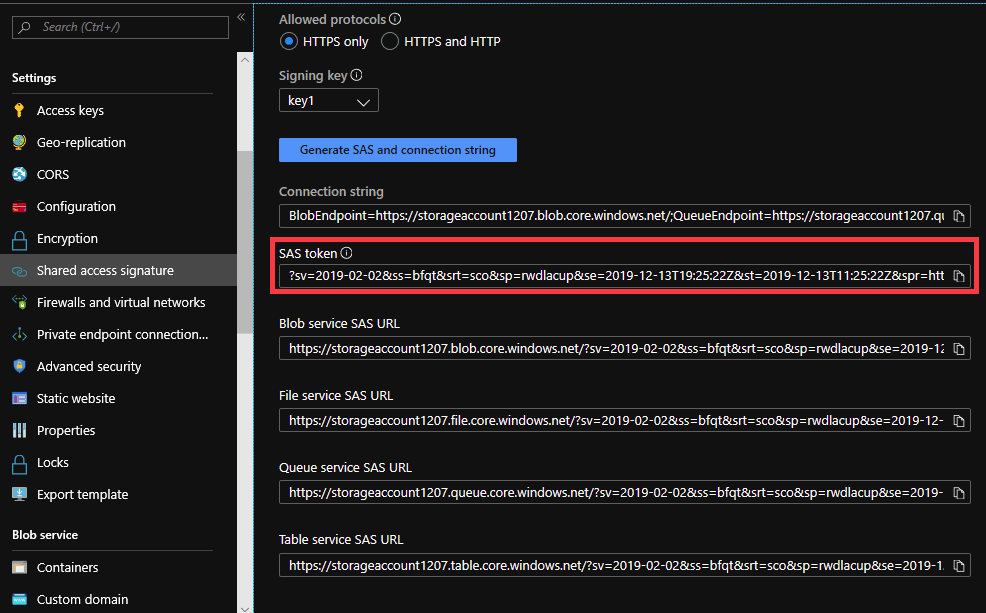
4) In the generated token, identify the values of "sv=", "si=", "tn=" and "sig=" and copy them to a notepad
5) On the Kondado platform, go to the add data sources page and select the Table Storage data source
6) Name your data source and enter the information from step (4),

Now just save the data source and start integrating your Table Storage data into the Data Lake or Data Warehouse.
Pipelines
Summary
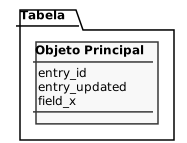
Relationship chart
Click to expand
Notes
- Part of this documentation was automatically generated by AI and may contain errors. We recommend verifying critical information
Add Azure Table Storage as a Kondado data source
Configure a Shared Access Signature token in Azure and register your Table Storage account on Kondado to start ETL pipelines.
Generate a Shared Access Signature in Azure
In your Azure account, open Settings and click Shared access signature. Leave all fields checked, then click Generate SAS and connection string to create the token.
Extract the token parameters
From the generated token, copy the values of sv=, si=, tn= and sig= to a notepad — you will need them in Kondado.
Add the source on Kondado
On the Azure Table Storage source page in Kondado, name your connection and paste the four parameters from the previous step.
Save and start integrating
Save the data source. You can now send Table Storage tables and views to your data warehouse or other destinations.
Configure incremental loads (optional)
If a table has a datetime/timestamp column marking inserts or changes, set it as the incremental key. Also define the primary key (single or composite) so Kondado identifies unique records.
Frequently asked questions
sv=, si=, tn= and sig= and paste them into Kondado when adding the Azure Table Storage source.datetime or timestamp column that records when a row was inserted or changed, you can use that column for incremental loads. You must also define the primary key so Kondado recognizes unique records.