Creating the data source
MySQL is an open source relational database that is behind many applications, being one of the most popular databases in the world. The data integration from MySQL to the Data Warehouse created by Kondado allows you to replicate your tables and views to your analytical cloud, in a comprehensive or incremental way (capturing only new and updated data).
Adding the data source
To automate the ETL from MySQL with Kondado to your database, follow the steps below:
- Whitelist the Kondado IPs on the database server (and on your VPC) for the port that will be used to connect with MySQL (usually 3306)
- On the Kondado platform, go to the page to add data sources and select the MySQL data source
- Give a name to your data source and fill in your database information
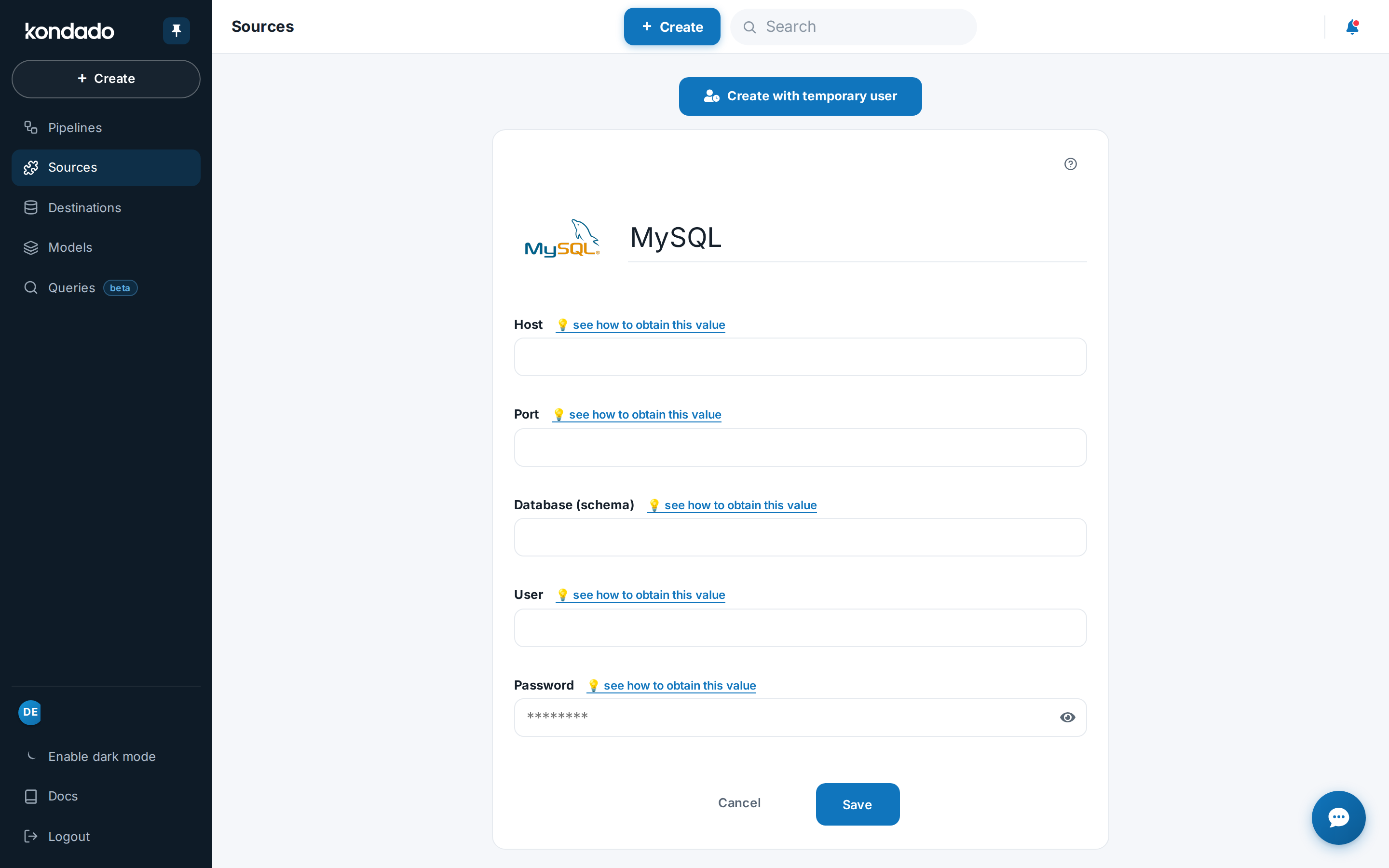
Now just save the data source and start integrating your MySQL data into the Data Lake or Data Warehouse.
Pipelines
Summary
Relationship chart
Click to expand
Notes
- With our integration, you can integrate tables and also views
- If your table has a datetime/timestamp type column that marks when a record was changed/inserted, your integration can be incremental
- It will be necessary to define the primary key, which can be defined by several columns and refers to the column (or set of columns) that define a record as being unique
- Part of this documentation was automatically generated by AI and may contain errors. We recommend verifying critical information
Add MySQL as a Data Source on Kondado
Configure MySQL as a source in Kondado to replicate tables and views to your Data Warehouse or Data Lake.
Whitelist Kondado IPs
Allow Kondado's IP addresses through your database server and VPC firewall for the MySQL port (typically 3306). This secure connection is part of Kondado's security practices.
Select MySQL on the platform
On the Kondado platform, navigate to the data sources page and choose MySQL from the available connectors.
Configure connection details
Name your data source and enter your database host, port, credentials, and database name.
Define primary key and sync mode
Set the primary key (can be composite) and choose between full or incremental replication. For incremental sync, identify a datetime/timestamp column that tracks when records are inserted or updated.
Save and start integration
Save the data source to begin replicating your MySQL tables and views to your Data Warehouse or Data Lake.