Data Munging, also known as data reprocessing or Data Wrangling, is the process of cleaning, transforming, and formatting data from its raw state to a standardized version that can be used for analysis.
Starting Data Pre-processing
In the Data Munging process, various techniques and tools are employed. Some of the most common steps include:
- Data Cleaning: Remove or correct errors, duplicates, or inconsistencies in the data.
- Missing Data: Deal with missing values through imputation or their exclusion.
- Data Transformation: Convert data into a suitable format or scale, such as standardizing numerical variables or encoding categorical variables.
- Feature Extraction: Create new features or derive meaningful information from existing features.
- Data Integration: Combine various datasets or sources into a unified dataset.
- Data Formatting: Convert data into a consistent structure or representation.
Tools
There are several tools and languages that assist in this process, but the most popular for data science and more advanced issues is the Python language.
Python: Python is a versatile programming language widely used in data science. It offers various libraries and packages, such as Pandas and NumPy, which provide powerful data manipulation and preprocessing capabilities.
NumPy mainly focuses on providing efficient numerical operations and working with homogeneous multidimensional arrays. It offers a powerful ndarray object and a wide range of mathematical functions for fast and efficient numerical calculations. NumPy is widely used in scientific computing, numerical simulations, and tasks involving large-scale numerical data processing.
On the other hand, Pandas is built on top of NumPy and is designed to handle structured data in a tabular format. It provides a high-level object called DataFrame, capable of storing and manipulating two-dimensional heterogeneous data. Pandas excel in data cleaning tasks, data preprocessing, exploratory data analysis, and data manipulation. It offers a rich set of functions and methods for filtering, grouping, merging, reshaping, and time series analysis.
In summary, NumPy is mainly used for numerical computation and efficient operations on arrays, while Pandas focuses on providing flexible data structures and data analysis tools for working with structured data. Although there is some overlap in functionality, Pandas is more suited for data manipulation and analysis, while NumPy is more geared towards numerical calculations and operations on arrays.
Examples:
Pandas:
In the example below, we will use the Pandas library to rename a column using the Python language.

Image 1
In Image 1, we find a problem because the "Cities" columns are written as state acronyms.
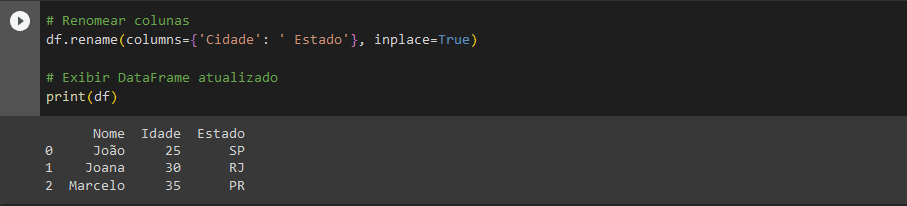
Image 2
Thus, in Image 2, the code updates "Cities" to "States".
If you have never had contact with the language, we will give a brief explanation of what was done:
import pandas as pd
Here, we are creating a dictionary named 'data' that contains information about people.
df = pd.DataFrame(data)
This line transforms the 'data' dictionary into a DataFrame. A DataFrame is a data structure that organizes information in the form of a table with columns and rows. Each key in the dictionary becomes a column in the DataFrame, and the values associated with each key are filled in the corresponding rows.
print(df)
This line prints the DataFrame to the console output, the screen we see.
NumPy:
In the next example, we will use the NumPy library to remove a column.
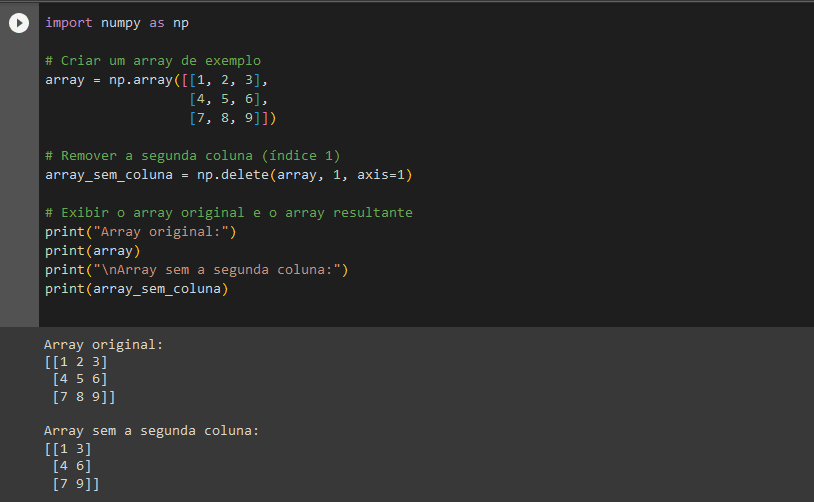
Image 3
Again, we will explain the code:
In this code, the NumPy library is imported as 'np'.
A two-dimensional array is created with values from 1 to 9, organized into three rows and three columns. Next, the second column of this array is removed using the 'np.delete()' function. The result of the removal is stored in a variable called 'array_without_column'. Finally, the code displays the original array and the resulting array in the output using the 'print()' function.
An array is similar to a list ([1, 2, 3, 4, 5]), but optimized for numerical and mathematical operations.
Other Tools
Other tools that can be used in the Data Munging or Data Wrangling process include:
- R: R is a programming language specially designed for statistical computing and data analysis. It has numerous packages, including dplyr and tidyr, which offer efficient data manipulation features.
- SQL: SQL (Structured Query Language) is a programming language used to manage and manipulate relational databases. It is widely used for queries, data extraction, and data manipulation in databases.
- Excel: Microsoft Excel is a widely used tool for data manipulation. It offers a variety of features for filtering, sorting, formatting, and transforming data. Although it is more suitable for smaller-scale tasks, Excel can be useful for basic data cleaning and transformation tasks.
The Importance of Data Munging
Data Munging is important because it helps us clean, organize, and transform raw data into a usable format for analysis. It ensures data accuracy by correcting errors and inconsistencies, allowing us to make informed decisions.
This entire process simplifies data analysis, enhances data quality, allows data integration, and improves the accuracy and efficiency of analyses.
This process is useful for various professionals, such as data scientists, data analysts, BI analysts, researchers, and professionals in areas such as marketing and sales.
As a result, Data Munging is part of a process that helps companies, organizations, decision-makers, and stakeholders obtain more accurate and meaningful insights.
Let's transform the way your company processes its data?
As you can see, Data Munging is a complex but essential process for any company that wants to gain valuable insights from its data. But you don't have to do it alone. At Kondado, we have a team of experts ready to help you transform your raw data into actionable information.
If you feel overwhelmed by the amount of data your company is generating, or simply don't know where to start when it comes to data preprocessing, we can help. Our services range from data cleaning to integrating different sources, ensuring you get the most accurate and meaningful insights for decision-making.
Conclusion
Data munging, or data preprocessing, plays a crucial role in preparing and transforming raw data for analysis. By cleaning, correcting, and formatting the data, the necessary accuracy and consistency are ensured to obtain reliable insights.
This process simplifies data analysis, improves data quality, allows the integration of different sources, and increases the efficiency of analyses. Professionals from various fields, such as data scientists and BI analysts, benefit from data munging, obtaining more accurate and meaningful information for informed decision-making.