BigQuery is a Bigdata solution created by Google that enables large-scale data storage and analysis. In this article, we'll show you how to register a BigQuery database as a destination on Kondado's platform, so you can centralize data from all your company's tools.
1) Login to your Google Cloud account
3) Once in the Service Accounts section, click on “CREATE SERVICE ACCOUNT”
4) In the first step, fill in a name for your Service Account (for example “kondado bigquery”) and click on “CREATE”
5) In the second step of the creation process, select the Roles “BigQuery Job User”, “BigQuery User”, and “BigQuery Data Editor” click CONTINUE
6) Now just click on “DONE” to finish the creation
7) Once created, you will be directed to a list of all active service accounts. Locate the one you just created and, on the three vertical points on the right, click on “Create key
8) In the dialog, select the type “JSON” and then click on “CREATE”
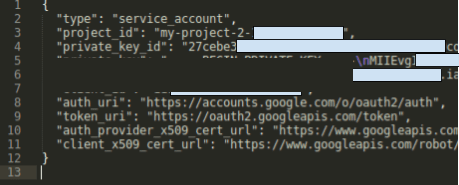
9) After clicking create, the key will be downloaded to your computer. Open the downloaded file in a text editor, it will look something like this:
10) Access the BigQuery page and get the project and dataset IDs of your destination in the Google console
13) Fill in your database information as shown below:
- In Project ID and Dataset ID paste the values obtained in step (10)
- In JSON Credential, copy and paste ALL the contents of the file downloaded in step (9), without any changes
ATTENTION: Make sure that the Dataset ID DOES NOT contain the project ID separated by “:”. For example, “id_project:id_dataset” is wrong. The correct thing is that the Project ID and Dataset ID are each separately in their respective fields
Now just save so that your destination is ready to receive the first pipelines!
Add BigQuery (Service Account) as a Destination on Kondado
Follow these steps to create a Google Cloud Service Account, generate a JSON key, and configure BigQuery as a data destination on Kondado's platform.
Create a Google Cloud Service Account
Log in to your Google Cloud account and navigate to the Service Accounts section. Click "CREATE SERVICE ACCOUNT", enter a name (e.g., "kondado bigquery"), and assign the roles "BigQuery Job User", "BigQuery User", and "BigQuery Data Editor" before finishing with "DONE".
Generate and download the JSON key
In the Service Accounts list, locate your new account, click the three vertical dots, and select "Create key". Choose "JSON" type and click "CREATE" to download the credential file. Open it in a text editor to copy the contents later.
Verify billing and collect project details
Ensure your Google Cloud project has active billing enabled. Then access the BigQuery page in the Google console to obtain your Project ID and Dataset ID for the destination configuration.
Add the destination on Kondado
Log in to the Kondado platform, navigate to the add destinations page, click "New Destination", and select "BigQuery Service Account" from the available options.
Configure destination credentials
Paste the Project ID and Dataset ID into their respective fields. In the JSON Credential field, copy and paste the complete contents of the downloaded key file without any modifications. Ensure the Dataset ID doesn't include the project ID with a colon separator.
Save and start building pipelines
Save your destination configuration. Your BigQuery database is now ready to receive data pipelines from your connected sources, enabling centralized analytics and reporting workflows.