Creating the data source
Kondado's connector allows you to access your objects and executions (quantities and dates) for your Kondado models and integrations — all completely free: the records integrated using this connector do not count toward your plan limit.
It's especially useful for tracking the number of integrated records directly in your database, helping you monitor your plan usage. It also enables the data integrated and modeled by Kondado to interact with the rest of your data ecosystem. For example, if you use our integrations to send data to a staging database before sending it to a production one, you can query the log tables to check when an integration or model was executed and trigger your internal processes accordingly.
Adding the connector
Requirements
The generated token inherits the same permissions as the user who creates it. Therefore, the user generating the token must have access to the accounts and workspaces from which they want to retrieve logs.
Instructions
To add the Kondado connector, you first need to generate a Kondado token — see how to do that here. Be sure to save both the token and the access key.
Then simply name your connector, paste in the previously obtained key and token, and click SAVE!
Pipelines
Summary
Relationship chart
Click to expand
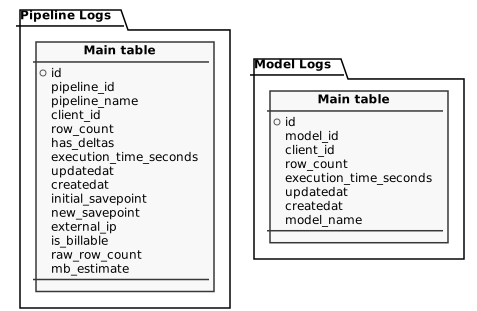
Model Logs
| Campo | Tipo | |
|---|---|---|
|
float |
[en] Log record ID |
|
|
float |
[en] Model ID. You can get it from the URL when accessing the model on the Kondado platform: app.kondado.com.br/models/[your_model_id] |
|
|
float |
[en] Kondado account or workspace ID to which the integration belongs |
|
|
float |
[en] Number of records in the final table generated by the model |
|
|
float |
[en] Time in seconds the model took to execute, excluding internal Kondado operations (e.g., connection setup) |
|
|
timestamp |
[en] Log update timestamp (UTC) |
|
|
timestamp |
[en] Log creation timestamp (UTC). The log is created after the model execution finishes |
|
|
text |
[en] Model name at the time the log was generated |
Pipeline Logs
Logs older than 90 days are not available
| Campo | Tipo | |
|---|---|---|
|
float |
[en] Log record ID |
|
|
float |
[en] Integration ID. You can get it from the URL when accessing the integration on the Kondado platform: app.kondado.com.br/pipelines/[your_integration_id] |
|
|
text |
[en] Integration name |
|
|
float |
[en] Kondado account or workspace ID to which the integration belongs |
|
|
float |
[en] Number of records inserted by the execution |
|
|
boolean |
[en] Whether the integration wrote records to the deltas table |
|
|
float |
[en] Time in seconds the integration took to run, excluding Kondado internal operations (e.g., connection setup) |
|
|
timestamp |
[en] Log update timestamp (UTC) |
|
|
timestamp |
[en] Log creation timestamp (UTC). The log is created after the integration finishes, so this field can be used similarly to the record count graph shown in the Kondado platform |
|
|
text |
[en] For incremental integrations, this field stores the initial savepoint value (from Sept 2020 onward) |
|
|
text |
[en] For incremental integrations, this field stores the final savepoint value (from Sept 2020 onward) |
|
|
text |
[en] This field stores the external IP of the server used to execute the integration |
|
|
boolean |
[en] Indicates whether the integrated records counted against your plan (TRUE) or were free rows (FALSE) |
|
|
float |
[en] Number of rows inserted by the execution. This field will be populated starting June 12, 2025; for earlier dates, the row_count field is equivalent |
|
|
float |
[en] Estimated size in MB of the data inserted by the execution |